

IRT Jules Verne, R&D Partner to the Construction Industry
The construction industry is currently facing several challenges: improving safety and working conditions on construction sites, increasing productivity amid persistent skills shortages, and continuing its environmental transition.
These challenges affect a sector with very specific operating conditions. Unlike a factory, a construction site is constantly evolving, with layouts, access constraints and working environments changing as work progresses. Automation and robotics solutions therefore need to be able to adapt to these specific conditions.
The environmental transition is another major challenge for the sector. It encompasses the energy performance of buildings, as well as materials, construction methods and, more broadly, construction practices.
IRT Jules Verne is addressing some of these challenges by drawing on expertise developed in other industrial sectors, particularly in robotics and automation.
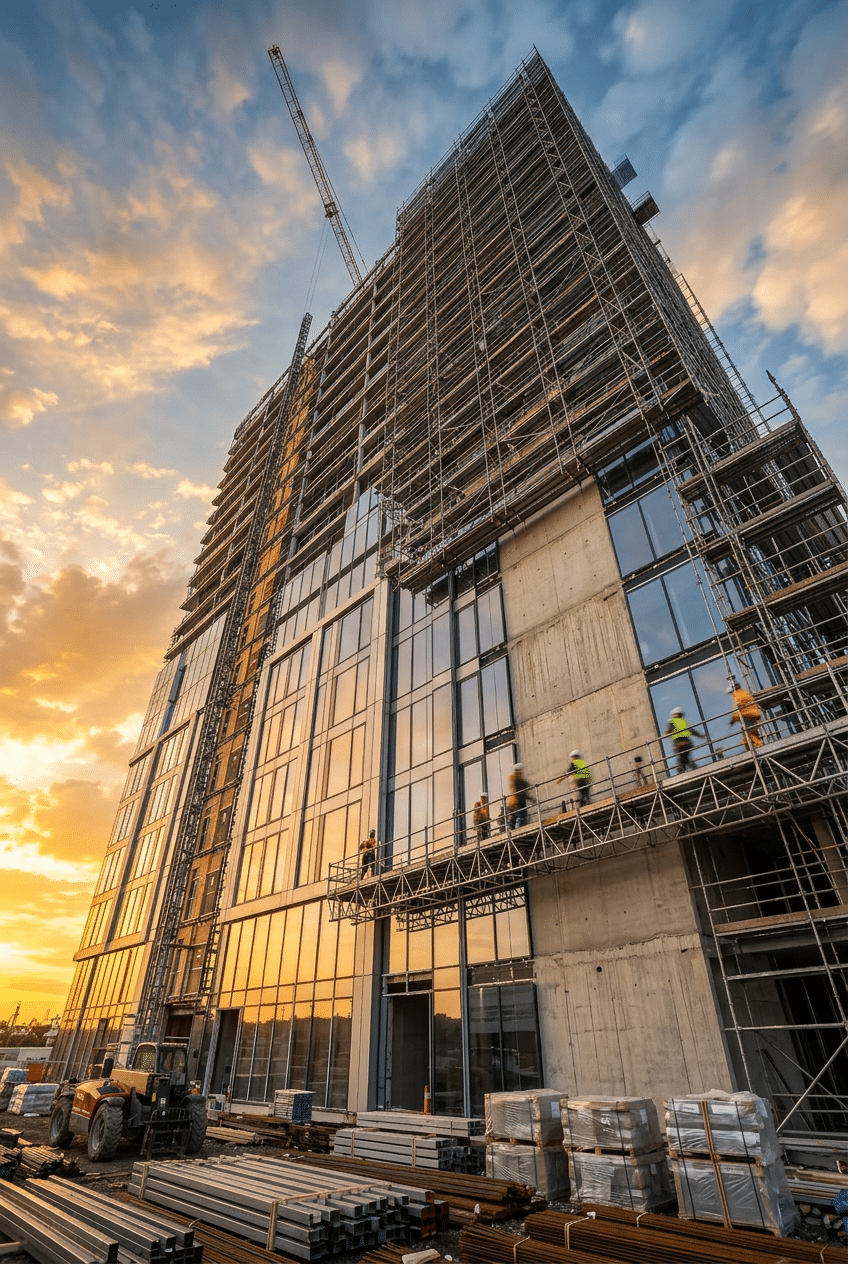
- Improving safety and working conditions on construction sites
- Improving productivity amid skills shortages
- Accelerating the sector’s environmental transition
Improving safety and reducing physical strain on construction sites
Jobs in the construction industry continue to involve demanding working conditions, including manual handling of heavy loads, repetitive tasks, working at height and operations in complex environments. Reducing physical strain and exposure to risks is therefore a key challenge for the sector, both to improve working conditions and make construction careers more attractive.
Mechanisation, automation and the robotisation of certain operations offer ways to reduce the need for human intervention in the most physically demanding or hazardous tasks.
Improving productivity in a sector facing recruitment challenges
The construction industry continues to face recruitment difficulties across many trades. In 2026, 65.2% of recruitment projects in the construction sector are considered difficult to fill, according to France Travail.
In this context, companies need to maintain their production capacity while adapting their working methods. Automation can help take over certain repetitive or physically demanding tasks, while enabling operators to focus on activities that require greater expertise and know-how.
Reducing the environmental footprint of Construction
The building sector still accounts for 15% of France’s gross greenhouse gas emissions. Decarbonising the sector requires building renovation and improved energy efficiency, as well as changes in materials and construction methods.
For industry stakeholders, the challenge is to reduce the environmental impact of construction while continuing to meet cost, quality and performance requirements.
TITANBOT : Automating tedious and hazardous tasks on complex Construction Sites
Transporting equipment and tools across large work areas remains a tedious and potentially hazardous task on many construction sites, often carried out in complex and constrained environments. Automating these operations offers a direct way to improve operator safety and working conditions.
This is the ambition of the TITANBOT project (ANR-23-DMRO-0020), which is developing cable-driven parallel robots capable of operating autonomously or in co-active mode. At VINCI Energies France, a first application focuses on transporting equipment to the upper floors of a building under construction using a mobile skip, with automatic unloading onto a secure and easily accessible platform. The entire system is designed to be easily dismantled and reassembled as the construction site progresses.
The project is also developing software for the design of cable-driven parallel robots, control strategies to ensure speed, accuracy and safety, techniques for calibrating mechanical parameters, as well as models for predicting human behaviour to improve operator acceptance and the ergonomics of these systems.
Launched in December 2024 for a period of 30 months, the project is expected to deliver two demonstrators during 2026, followed by a final evaluation report in 2027.
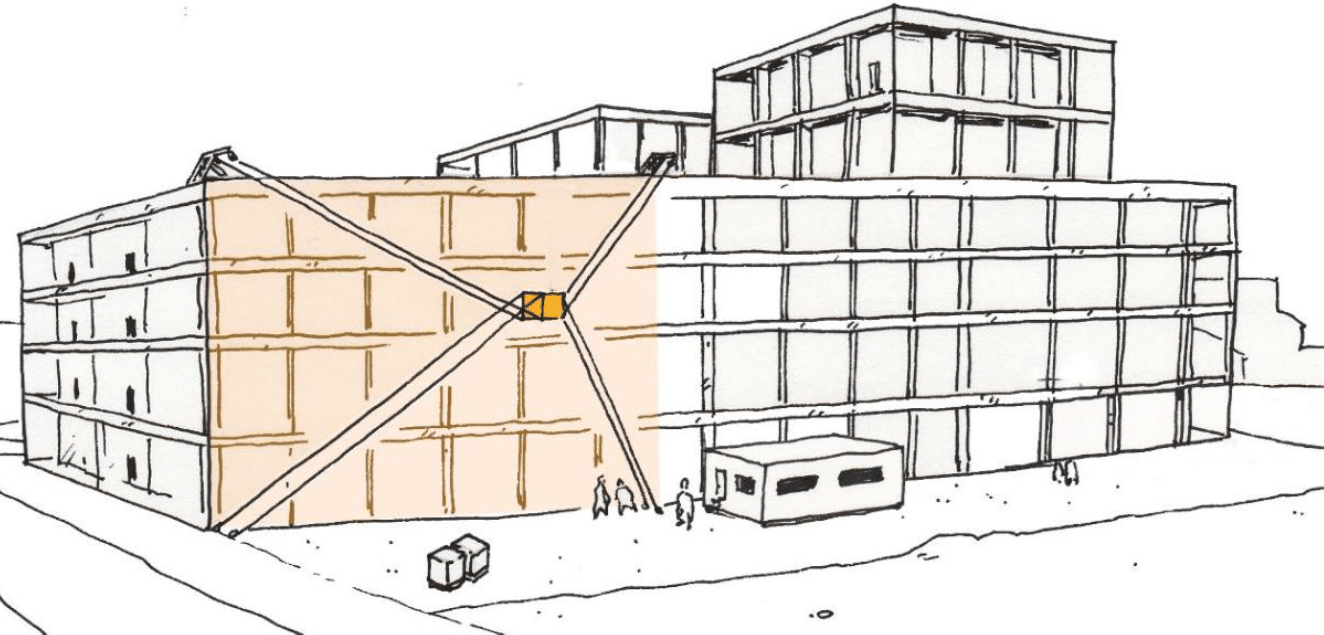
Bringing together industrial and academic expertise around TITANBOT
TITANBOT brings together a consortium led by IRT Jules Verne, combining academic research and industrial expertise:
- VINCI Energies, focusing on equipment transport on construction sites, and Actemium, a VINCI Energies subsidiary specialising in industrial automation;
- CETIM, providing mechanical and robotics expertise;
- Orano, focusing on the automation of radiological inspection in nuclear environments, a related application developed as part of the same project;
- LS2N and LIRMM, working on the design of cable-driven parallel robots.
The project is funded by the French government as part of the France 2030 investment plan, under the Défi Transfert Robotique call for projects managed by the French National Research Agency (ANR).