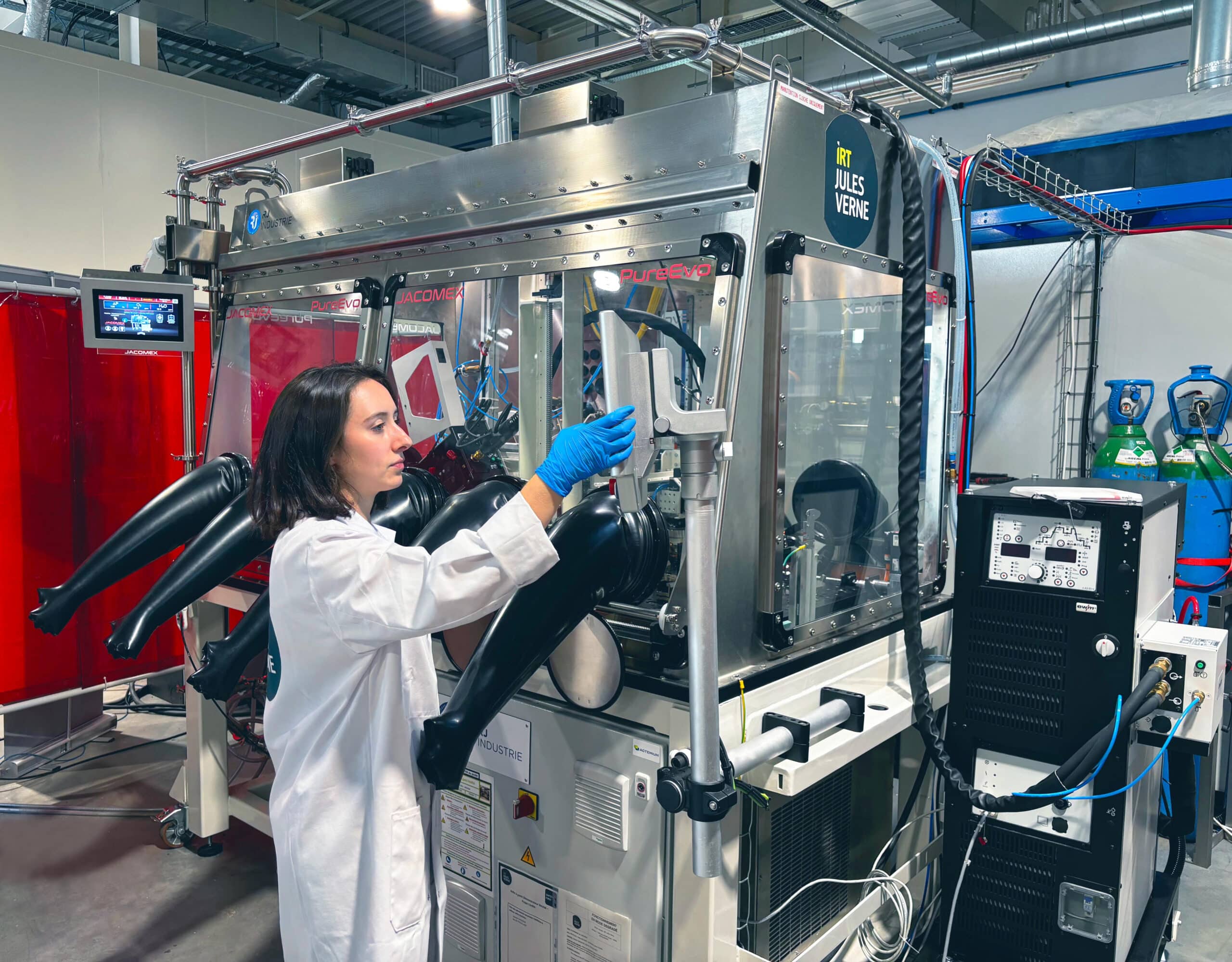

IRT Jules Verne, R&D Partner to the Defence Industry
As an R&D partner to the naval defence industry, IRT Jules Verne has conducted more than 30 collaborative projects and feasibility studies with Naval Group since 2012, including 16 since 2020, with seven currently under way, across sites ranging from Lorient and Indret to Cherbourg. This long-standing relationship of trust has established the Institute as a recognised point of access to France’s Defence Industrial and Technological Base (BITD) and its major prime contractors. Nearly half of this work focuses on robotics and welding automation, complemented by composite and metallic materials processes and modelling & simulation—three areas of expertise at the heart of the naval defence industry’s needs.
Today, this expertise extends beyond the naval sector: IRT Jules Verne is conducting several research projects with Safran and is working alongside Airbus Helicopters and Leonardo S.p.A. on the European ENGRT II project, dedicated to next-generation military helicopters. These two examples illustrate the Institute’s ability to support the entire defence industrial value chain, from naval defence to military aeronautics.
The defence industry must combine the responsiveness required by the geopolitical context with industrial control and technological sovereignty, in a sector where shortages of critical skills remain a genuine barrier to increasing production capacity.
To address these challenges, IRT Jules Verne draws on its expertise in robotics, composite and metallic processes, simulation and non-destructive testing. It also builds on the experience gained through close collaboration with naval defence companies and, more broadly, with the entire defence industrial value chain.
- Ensuring industrial sovereignty & confidentiality
- Accelerating production Ramp-Up
- Maintaining production capabilities amid skills shortages
Ensuring industrial sovereingty and confidentiality
Sovereignty lies at the heart of the defence industry. France’s Defence Industrial and Technological Base must ensure the country has autonomous design and production capabilities, independent of foreign solutions, for equipment whose availability is critical to national strategic autonomy.
This challenge goes hand in hand with a requirement specific to the sector: confidentiality. Alongside quality and operational safety, confidentiality is a fundamental pillar of any technological development intended for defence applications.
These dual requirements underpin several projects conducted with Naval Group, including ICOME, which evaluates non-destructive testing (NDT) techniques (ultrasonic testing and X-ray radiography) with the aim of developing a sovereign automated inspection solution for military naval composite structures, and MONOCLE, which is developing a real-time monitoring methodology for the infusion process of one-off, highly critical composite parts.
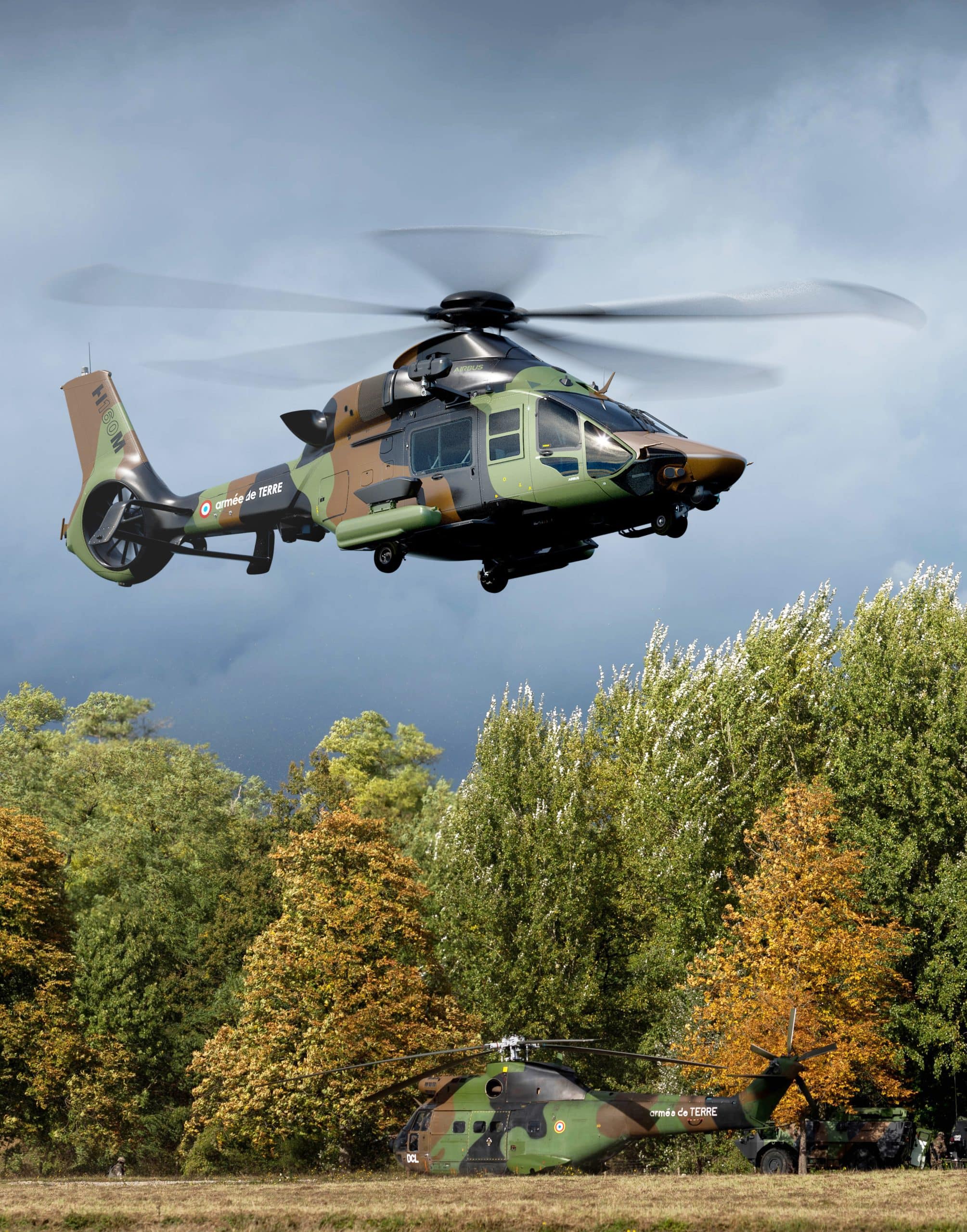
At the European level, IRT Jules Verne contributes to the ENGRT II project, coordinated by Airbus Helicopters with Leonardo S.p.A. as co-lead, within a consortium of 53 industrial and institutional partners. This three-year project, co-funded by the European Union under the European Defence Fund (EDF), aims to advance the critical technologies needed to protect Europe in highly contested environments. IRT Jules Verne contributes its expertise in metallic materials and processes, as well as monitoring, inspection and testing.
Accelerating production ramp-up while adressing the constraints of low-volume production
Driven by the geopolitical context and the shift towards a war economy, the defence industry needs to significantly increase its production capacity. However, unlike other defence sectors that must respond to very large increases in production volumes, naval defence typically involves small production runs or even one-off vessels, with significant variations in configuration from one ship or programme to another.
This is precisely the challenge addressed by the HIGHVAR project, which is developing robotic production systems capable of adapting to unforeseen events and production variations typical of the low-volume manufacturing environment of the defence industry.
In naval defence, the SmartRobot project, conducted with Naval Group, Europe Technologies and CETIM, is developing robotic solutions for welding ship frames and floors. The HAPPY 2 project, conducted with Airbus, Naval Group, ACsystème, CNRS (LS2N), IMT Atlantique and INRIA, focuses on automating the assembly of large structures using positioning systems controlled by visual sensors.
The AMATSUMARA project, conducted with Groupe Briand, Naval Group, Lucas, Proxinnov, CNRS (LS2N), Centrale Nantes and Nantes Université, takes this level of precision even further, targeting sub-millimetre positioning accuracy for long, heavy metal parts prior to welding—a capability directly linked to industrial sovereignty in large-scale assembly.
Maintaining production capabilities through automation and robotics
Naval defence shipyards still rely heavily on manual operations carried out in constrained industrial environments. Against a backdrop of shortages in certain industrial skills, automation and robotics offer ways to maintain production capacity while supporting operators in their work.
IRT Jules Verne develops and tests these solutions with Naval Group. The PACE project enabled the automation and intelligent supervision of a pipe manufacturing line, demonstrating the benefits of cobotic assistance in production workshops. This was followed by a project to automate pipe marking, which enabled the robotisation of positioning and collision-free path generation, supported by a human-machine interface designed to facilitate collaboration with the operator.
This development of robotics expertise is supported by a Qualiopi-certified training programme: for example, IRT Jules Verne delivered a ROS2 training module for Naval Group teams.
Our flagship projects
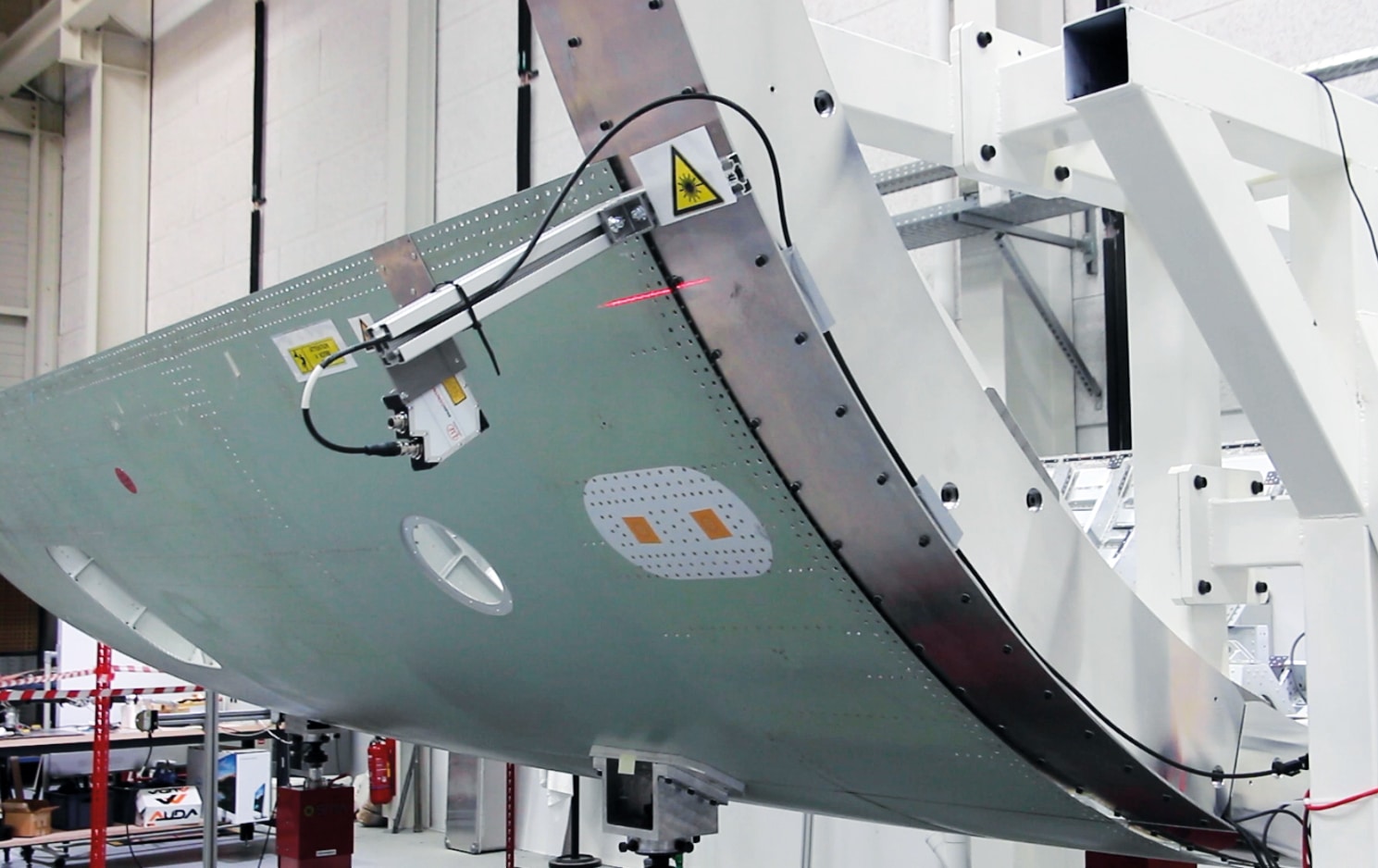 Automating the Precise Assembly of Large Structures with Continuous Servo Control
HAPPY and HAPPY2 projects develop lightweight and flexible positioners, driven by local or global measurements, to handle and position large parts in the aeronautics and naval defense industries.
Read the case study
Automating the Precise Assembly of Large Structures with Continuous Servo Control
HAPPY and HAPPY2 projects develop lightweight and flexible positioners, driven by local or global measurements, to handle and position large parts in the aeronautics and naval defense industries.
Read the case study
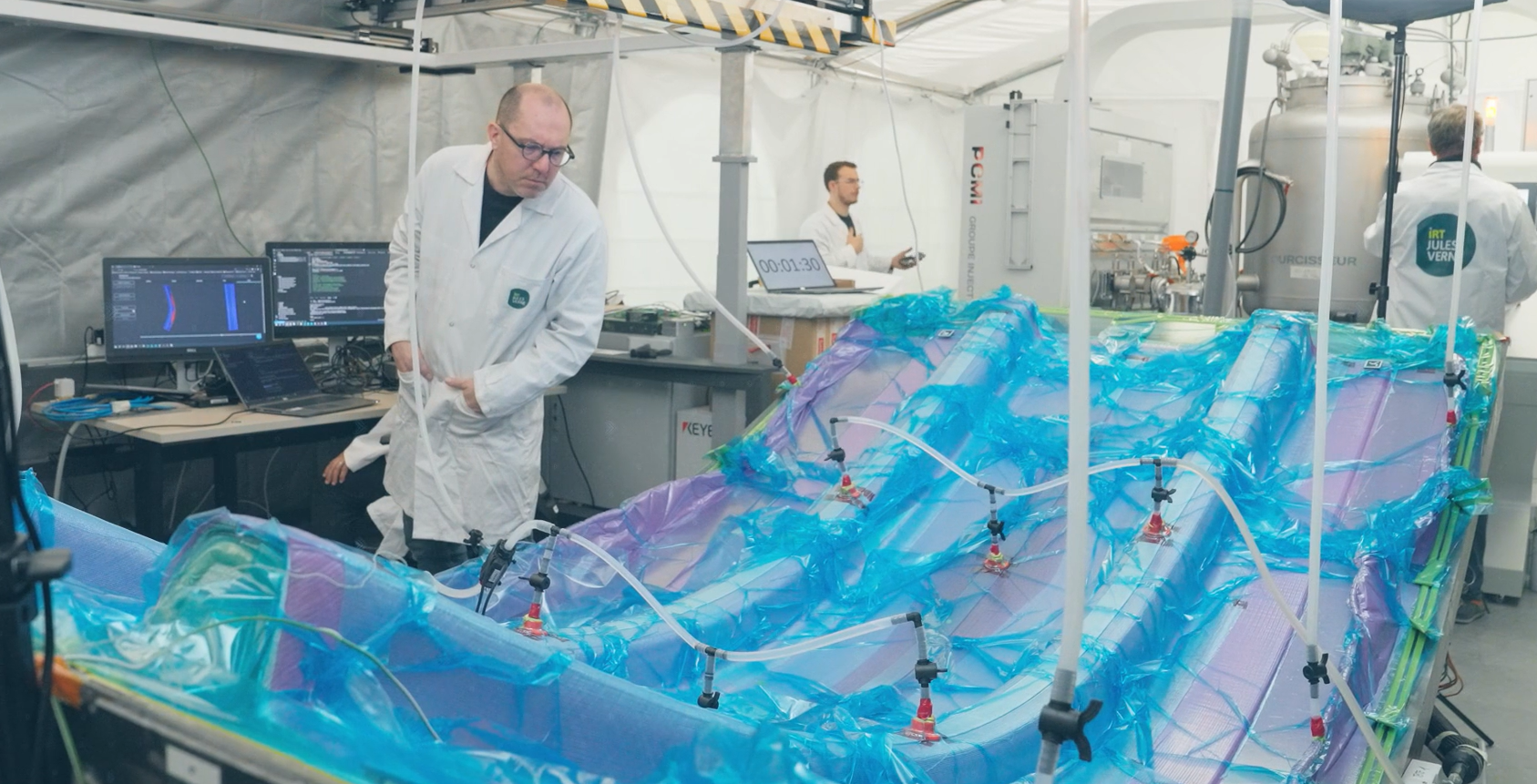 Making composite processes more reliable thanks to real-time monitoring
The Monocle project is developing an innovative real-time monitoring and decision support solution to secure the infusion processes of large composite parts.
Read the case study
Making composite processes more reliable thanks to real-time monitoring
The Monocle project is developing an innovative real-time monitoring and decision support solution to secure the infusion processes of large composite parts.
Read the case study
Key member in the Defence
NAVAL GROUP
These industrial partners make a long-term commitment to co-develop IRT Jules Verne’s technology and programme roadmap, in line with the sector’s key priorities. By becoming a member of IRT Jules Verne, you gain access to strategic opportunities that create tangible value for your organisation.